

From the macroscopic perspective of plant physiology and ecology, Photosystem II (PSII) is often regarded as the "pacemaker" of the intricate factory of plant photosynthesis. As the primary site for the conversion of light energy into chemical energy, the state of PSII directly determines the plant's growth potential and stress resistance. In modern plant science research methods, the OJIP rapid fluorescence kinetic curve has gradually evolved into the core "fingerprint" for detecting the primary photochemical reaction mechanism of PSII. This transient process not only carries crucial information about the photosynthetic apparatus's transition from dark adaptation to photosteady state, but also places almost stringent demands on the temporal resolution, signal-to-noise ratio, and data processing capabilities of measurement tools. From an industry development perspective, modern chlorophyll fluorometers are undergoing a profound transformation from simple relative fluorescence value readings to microsecond-level kinetic analysis and intelligent data ecosystems.
The OJIP curve is called the "fingerprint" for detecting PSII state because it exhibits a characteristic O-J-I-P multiphase rising phase within an extremely short timescale (usually within 1 second) after illumination. The rapid rise phase from point O (initial fluorescence Fo) to point J (approximately 2 ms) is crucial for understanding the opening and closing processes of the PSII reaction center. The fluorescence signal changes extremely drastically and rapidly during this phase; insufficient sampling rate can easily lead to the loss of key feature point information, resulting in misjudgments of photochemical efficiency.
The focus of technological evolution in the industry is increasingly shifting towards accurately capturing this transient process. Traditional measurement equipment is often limited by hardware performance, making it difficult to obtain stable data on sub-millisecond timescales. However, current advanced chlorophyll fluorometers generally possess microsecond-level sampling capabilities. For example, a sampling rate of 10 μs has become a threshold standard for resolving rapid kinetic curves. This means that during the O-J phase, the instrument can collect data points at extremely high density, thus accurately reconstructing the dynamic process of electron transport.
However, simply increasing the sampling rate is insufficient to solve the problem; sampling accuracy also determines the scientific value of the data. Under saturated pulse excitation with a light intensity as high as 23000 μmol·m⁻²·s⁻¹, the sensor must process high-intensity light signals in an extremely short time. At this point, 16-bit sampling accuracy becomes particularly crucial. Compared to low-precision analog-to-digital conversion, 16-bit accuracy provides a wider dynamic range and finer grayscale levels, ensuring that both weak Fo signals and saturated Fm signals can be captured linearly and without distortion. This combination of microsecond-level speed and high bit accuracy fundamentally solves the signal-to-noise ratio trade-off in the analysis of the PSII reaction center closure process, providing researchers with reliable basic data.
In field ecological monitoring or crop phenomics research, the diversity of samples presents a significant challenge to measurement equipment. From withered leaves with weak fluorescence under severe drought stress to thick leaves with extremely high chlorophyll content, even exhibiting a "light-shielding" effect, the differences between samples are vast. Traditional fixed-gain amplifier circuits often suffer from two trade-offs: at high gain settings, strong signals are prone to saturation and overflow; at low gain settings, weak signals may be drowned out by background noise.
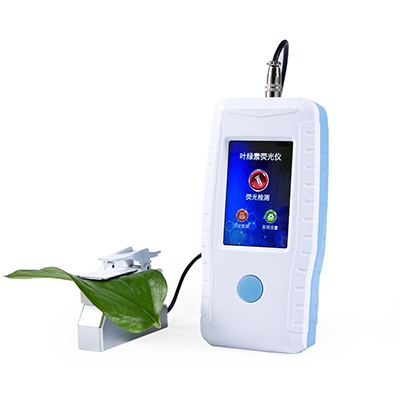
To address this pain point, dynamic range adaptive technology has become an important benchmark for evaluating the performance of modern chlorophyll fluorometers. Through multi-level sensor gain adjustment (e.g., six gain levels from 1 to 20 offered by some devices), the instrument can automatically match the optimal range based on the actual fluorescence intensity of the sample. The breakthrough of this technology lies in its significant broadening of the linear boundary of the measurement. When used with a 455nm LED blue light excitation source, the device can more effectively excite chlorophyll molecules. Simultaneously, the precise optical design of the PIN diode and fluorescence bandpass filter filters out stray light interference, accurately extracting characteristic fluorescence signals.
This technological advancement not only improves data accuracy but also expands the instrument's application scenarios. Researchers no longer need to frequently change equipment or repeatedly adjust parameters for different samples; the instrument itself is capable of adapting to complex sample environments. For large-scale measurement work such as germplasm resource screening, this means higher data efficiency and a lower operational threshold. If high-performance hardware is the "skeleton" of a chlorophyll fluorometer, then a robust computing and data ecosystem is its "brain." With the maturation of the JIP-test theory, basic parameters such as Fo and Fm are no longer sufficient for in-depth mechanistic research. Researchers are increasingly focused on energy flow distribution parameters derived from OJIP curves, such as ABS/RC (energy absorbed per unit reaction center), TRo/RC (captured energy), ETo/RC (electron transfer energy), and PI_Abs (absorption-based performance index). This necessitates instruments with powerful online computing capabilities, capable of converting raw data into more than 26 physiological parameters the instant measurement ends.
At the data management level, the industry is undergoing a shift from "data silos" to "cloud interconnection." Traditional equipment is often limited by local storage, making data export cumbersome and prone to loss. New-generation equipment introduces WiFi data upload functionality, supporting direct transmission of test results to cloud platforms. This design breaks down the physical barriers between the laboratory and the field, and between the measurement and analysis ends, enabling the real-time aggregation of large-scale ecological monitoring data. With a massive local storage capacity of 99,999 records and convenient USB and Type-C data transfer interfaces, researchers can easily build a physiological parameter database containing tens of thousands of samples, laying the foundation for subsequent big data analysis.
Furthermore, user-friendly human-computer interaction design is an indispensable trend. The addition of a 3.5-inch touchscreen and one-click switching between Chinese and English lowers the barrier to entry for non-professional operators; while details such as real-time battery level display and over-temperature protection ensure long-lasting operation and stability in complex field environments. These seemingly minor features are actually a crucial step in the instrument's transition from the laboratory to widespread application.
As research on photosynthesis delves deeper into its microscopic mechanisms, chlorophyll fluorometers are no longer merely reading tools, but have become a key hub for analyzing plant stress physiology and light energy utilization efficiency. From the precise capture of PSII photochemical reactions at microsecond-level sampling rates to the compatibility of dynamic range adaptive technology with complex samples, and the construction of a cloud platform data ecosystem, these technological advancements collectively constitute a panoramic view of the modernization of plant physiological detection equipment. In the future, with the further integration of sensor technology and data analysis algorithms, we have reason to believe that this field will continue to develop towards higher throughput, higher precision, and deeper intelligence, providing stronger technical support for revealing the mysteries of plant life activities.